

Author Introduction
Hello! My name is Ayiana Crabtree. I use she/they pronouns, and I’ve been the student success librarian at SUNY Polytechnic Institute for a little over 2 years as of writing this. While AI Literacy isn’t a part of my job description, the rise of AI technology and push for AI use in SUNY (that’s the NY state college system) has made thinking about AI inevitable (unfortunately). As I’ve been educating myself and in turn trying to educate others on my campus about such topics, I found myself intrigued by the overlap between what has been called the “Literacy Crisis” and AI use. That led to the research that backs the presentation I gave, and the following script-turned-blog-post. If you’re interested in the slide-deck for the presentation, you can view that here.
So, What is the “Literacy Crisis”?
Most recently, the cover article of the August 2026 edition of the Atlantic boldly claims “The Age of Reading is Over,” (or as the newly changed title states, “The End of Reading is Here”) but what does this really mean? Sure, it’s pretty clear that social media use is eating away people’s time, but so did the TV before the cellphone, and so did the radio before that – there’s always SOME new thing that overturns the current norm and has people upset – (like how 126 years ago the Atlantic published an article about how newspapers were overshadowing traditional literature!). This presentation will get into why AI is a whole different beast, however, not as a time eater, but a way to offload tasks from the brain entirely.
So what is this “Literacy Crisis,” what does it mean, and why is it being presented as an ever-increasing issue?
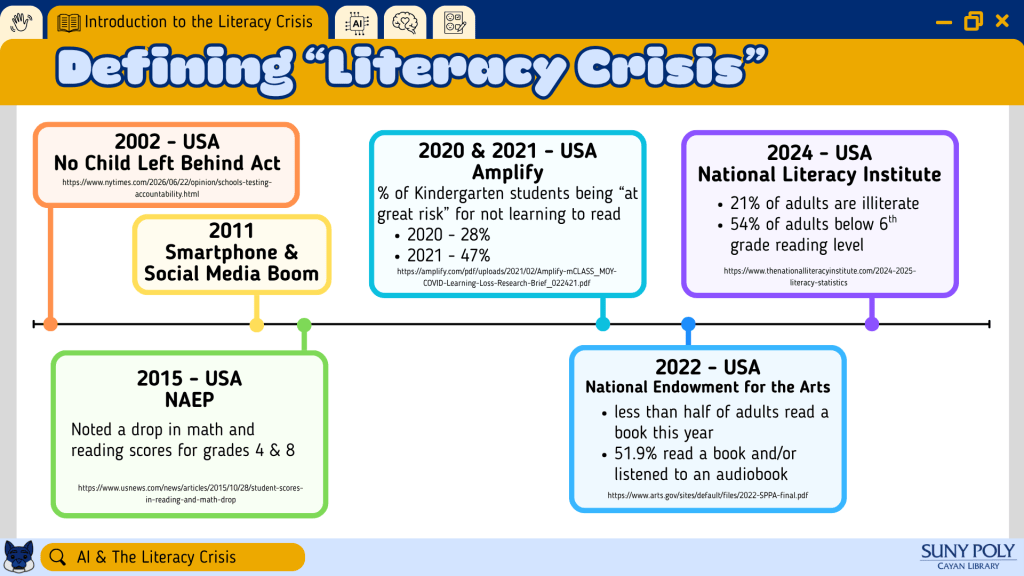
If literacy is the ability to read, write, and communicate, a literacy crisis would be simply defined as a wide-scale loss of these skills.
In 2024, the National Literacy Institute published their findings that 21% of adults in the United States are illiterate, and 54% of adults have a literacy below a 6th grade level.
In 2022, the National Endowment for the Arts’ report showed that less than half of adults reported reading a book in the past 12 months (if you factor in audiobooks, this statistic changes to 51.9% who read books and/or listened to audiobooks). They also “unpacked” those survey results in this article.
In 2021, 47% of kindergarten students were “at a great risk for not learning to read” – a large jump from 28% in the year 2020, as reported by Amplify.
2015 marked a year where there was a noted drop in student scores for reading and math while previous years had been holding steady.
These statistics are to show that while suddenly thrust into the spotlight again, the idea of a “Literacy Crisis” isn’t new. Some point to the “No Child Left Behind Act,” implemented in 2002 and replaced at the end of 2015 may have had an impact https://www.nytimes.com/2026/06/22/opinion/schools-testing-accountability.html – claiming that this may have incentivized schools to simply pass students who may have benefitted from further help. (in 2015, ⅓ of school districts students were a full grade level below intended).
Perhaps it was even something slightly before then, with the 2011 boom of the smartphone and social media eating away at people’s time and attention. Afterall, smartphone bans in school are only taking off in popularity in the past few years.
A Small Tangent about Social Media
It would feel wrong to not talk at least a little about how social media plays a role, as for a lot of people, social media is where they learn about AI (whether that be through AI image and video generation trends, or even the AI features or chatbots that are being integrated into social media platforms).
It’s probably no mystery that algorithms are going to be designed to keep you scrolling, after all, that’s how the social media companies are making their money, through advertisements served to you via your feed.
Unfortunately, the predatory nature of algorithms is nothing new. Back in 2021 the Wall Street Journal, with the help of a Facebook Whistleblower, released the “Facebook Files” that revealed many troubling facts about how the platform was run. In most relevance to my point about algorithms, it was uncovered that in 2018 Facebook made some changes to its algorithm in an attempt to make the platform “healthier” by encouraging interaction with family and friends. However, this change backfired, leading to posts focused on outrage and sensationalism to soar, as the algorithm weighed these highly reshared posts higher for sharing on people’s feeds. (Essentially, the more comments, or in this case arguments, on a post, the more points it earned to then appear in people’s feeds.) Internal memos from Facebook researchers noted that “Misinformation, toxicity, and violent content are inordinately prevalent among reshares,” and while this was negative for users, it was keeping them more engaged on the platforms.
This notion was further solidified earlier this year, when whistleblowers from Meta and TikTok were interviewed by the BBC. The Meta employee boldly claimed that senior management told the engineers to allow more “borderline” harmful content (including things like misogyny and conspiracy theories) into users’ feeds to allow for better competition with their Reels competitor, TikTok. On the other side, the TikTok employee shared access to the company’s internal dashboard of user complaints, which revealed that staff had been instructed to “maintain a strong relationship” with political figures to avoid threats of regulations or bans of the app, rather than protecting users from risks regarding harmful posts featuring children.
In addition to the algorithms being built to keep you engaged and scrolling, at the same time, your brain chemistry is being impacted. In 2022 the term TikTok Brain was coined, with researcher John Hutton going on to compare scrolling TikTok to a lab rat pushing a button and getting a dose of cocaine. In 2024, the Oxford Word of the Year was “Brain Rot” – defined as the supposed deterioration of a person’s mental or intellectual state, especially viewed as the result of overconsumption of material considered trivial or unchallenging. Short-form video content is the epitome of “trivial” content, giving the brain fast, frequent bursts of dopamine. This quick reward cycle keeps the brain searching for the next burst, reinforcing the habit of endlessly doom scrolling.
Why did I go on this tangent? Well, if people are spending all their time scrolling on the ever-addicting social media, not only is their time to do other activities decreasing, but at the same time, their willingness to spend long amounts of time on other activities decreases as well. THIS is where AI comes into the picture.
AI Steps Into the Picture
As the magical machine is, you can ask it anything and immediately be provided with an answer. Pretty cool, right? No need to spend time combing through sources to find the perfect quote for your essay, ChatGPT can do that for you. Oh, what’s that? The source doesn’t exist? No problem! You weren’t going to fact check that anyway, let’s hope the professor doesn’t either.
Ok but in all seriousness, it’s pretty easy to see why people are buying into AI so heavily. Even putting the “TikTok brained” youth aside, a lot of professionals are overworked and underpaid, so AI might seem like a helpful tool to lighten that heavy load. And that’s how it starts. Before we slide down that slippery slope, let’s back it up just a tad to set a definition of AI, and explain a little how it works.
How Does it Do That?
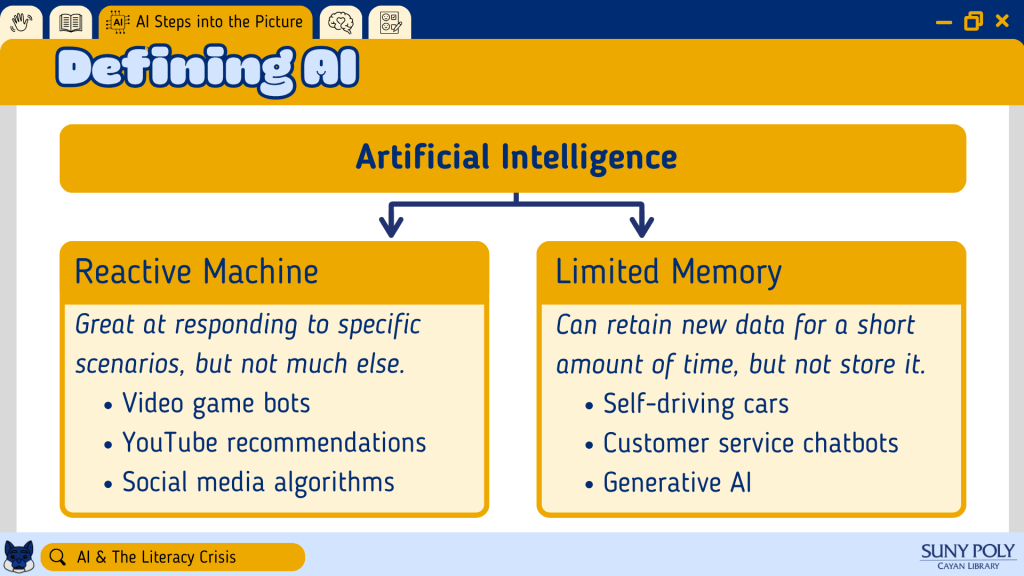
Artificial Intelligence as a whole can be broken down into two main categories, reactive machine AI and limited memory AI. Reactive machine AI are things like your social media algorithm, or non-player-character video game bots. They’re good at doing what they do in their specific scenario, but can’t do much beyond that. Then, on the other side, we have limited memory AI. These are the slightly more advanced forms of AI, things like a self-driving car or a large language model like ChatGPT.
Usually when you hear people talking about AI on social media, they’re more often than not referring to Generative AI or LLMs – those smart know-it-all chatbots. I will do my best to refer to it as Generative AI as this is the aspect of the technology that brings the most intrigue to this topic.
Now, let’s do a little overview of how these generative AI models work. When you type in a question (we’ll call that a prompt), what’s actually going on behind the scenes in the milliseconds it takes for the model to give you the answer? This is where the model has been trained to turn your plaintext language into something it can understand and process – tokens. OpenAI, the company behind ChatGPT simplifies this for us nicely, think of 75 words being equivalent to around 100 tokens. this means a token could be part of a word, a whole word, or even a few words together. Once the LLM converts your prompt into tokens, it then analyzes the positioning of those tokens, how near or far they are to other tokens, what order they are in, etc. and it’s that process that allows the model to “understand” your prompt. Once analyzed, the model then starts giving the output which appears on your screen as words being pieced together one by one. Side Note: OpenAI has a fun little token visualizer, if you’re interested to test out different sentences!
From those tokens the LLM is able to pull from its training to determine what the “best response” to your prompt was, and this is usually where you start hearing about 2 things: Training Bias and Hallucinations.
The Flaws
Training bias is the idea that depending on the model and who trained it, the outputs may show bias to one opinion over another. A 2025 study titled “Language-Dependent Political Bias in AI” showed that not only do different AI models show different political biases, but also the language in which you interact with the bot will change that political bias – this is due to the materials available in different languages that were used for training, as well as the views of the people for each language that helped in the training processes.
Hallucinations are the more commonly targeted “issue” when it comes to LLMs, in which AI models will sometimes produce outright false information in response to a prompt. This is a core flaw of AI models, because they do not have the ability to “know” anything, rather are simply providing their responses based on training data available and what fits the patterns it was trained on. Such hallucinations can happen even with closed models trained off fixed datasets. As reported by the NYT, with the help of a data scientist, Rabbi Josh Fixler trained an AI chatbot trained on his old sermons, which he named “rabbi bot”. In one of the sermons Rabbi Bot created, it hallucinated a quote from the Jewish philosopher Maimonides which Rabbi Fixler says “would have passed as authentic to the casual listener.”
Using Generative AI?
Now that we have a basis set for understanding how generative AI works, and the two main pitfalls that are Training Bias and Hallucinations, we can start thinking about the ways in which people might be using AI to lighten their workload. Doing a google search “How can AI help me with my work” brings up the google AI overview which summarizes the top reddit posts, YouTube videos, and other relevant articles into a nice neat list of ways that I might consider using AI. So let’s look at what that says.
- Automating routine tasks such as scheduling or taking meeting notes
- Creating content like emails, checking tone and clarity, or brainstorming ideas
- Generating summaries for lengthy articles, documents, and creating key takeaways…
Hold on a minute! AI has already done that last point for me without me even seeking it out to do so. And I didn’t even ask it to. Even if you’re not interested in using AI, these features are being integrated into just about every platform.
I did, in researching for this presentation, find out that you can get rid of it by clicking the “more” dropdown underneath the search bar and clicking “web” which then only shows you the web links, but this only lasts for the instance of that window you have open, and you’ll need to re-enable that every time you search in a new tab. Something is better than nothing I guess!
Say I didn’t mind. Sure, the google AI overview can be a helpful shortcut, but when we think back to things like algorithms and even AI training bias, how can we know that the “most relevant results” are actually going to be the best outcomes? Google states that “Ads in AI Overview are available” then goes on to clarify that “Ads can trigger on a subset of queries when AI Overview show if certain conditions are met, including if there’s commercial intent detected, and Google can show quality ads that are relevant to the user query” This basically means that while a company can’t outright pay to be the top answer to every AI overview, but if their content is deemed relevant to someone’s query, it can be shown.
ANYWAY – back on track. AI can be a helpful tool for certain situations, if a college doesn’t offer a wide range of tutoring for students, AI can be a tool to fill the gap. If you’re really busy with work, an AI scheduling assistant or notetaker could be a great timesaver. What it really comes down to is intentionality, frequency, and contextual decision making. How important is that email? If you’re writing an email to the head of your department and want someone to look it over, you might use AI to check for spelling mistakes, but you probably wouldn’t want to trust it to write the whole thing for you. If you just need to quickly acknowledge a meeting invite, however, maybe the AI suggested response will work! How important is that reading? Maybe you’re super busy but you need to read an article for a meeting. Do you have the time to read or skim it yourself, or will a brief AI overview suffice? Then you might be left wondering if the AI was even able to access the article, so maybe it would be better to skim it yourself… What’s the difference between an AI overview and something like, say, sparknotes for a classic novel students have to read for a class? Not everyone has the fortitude to pull an all-nighter reading Orwell’s Homage to Catalonia, so perhaps a quick summary will do (it’s not like you’re going to remember it in a week’s time anyway!).
Each situation is going to have its moments where you need to pause and ask how important something is, if you have the time to take on that task, and if AI could help in that situation. But the real issue is that most people aren’t taking that time to consider the options. Remember how I was talking about attention span earlier? If you’ve delved into the world of using AI you’re probably either using it sparingly to test a few things or you’ve gone all-in. And that’s where we loop this back into the Literacy Crisis. Sure, generative AI has produced a plethora of tools to help aid in a variety of tasks, but many people are taking a screwdriver and turning it into a magic wand. That is to say, those tools are doing more and more of the work until they’re basically creating the entire product. We can advocate for the “ethical” or “correct” or “educational” applications of generative AI products, but if you have a student working on a project that says “try using AI to help you create the outline for the paper” what’s a few extra clicks to have it do the entire assignment on their behalf? By pawning off tasks to AI, you could easily argue that you’re losing out on skills that would be honed or refined by doing the tasks yourself. But ultimately it’s up to each person to decide for themself if they care about putting in that effort, or slowly losing that skill over time.
Let’s take a look at what the research shows.
The Research
In June 2025 MIT published their findings on a study that explored the neural and behavioural consequences of LLM-assisted essay writing. This study, titled “Your Brain on ChatGPT: Accumulation of Cognitive Debt when Using an AI Assistant for Essay Writing Task” studied 54 participants working on an essay writing task. The participants were split into groups of “LLM group” “Search Engine group” and “Brain-Only group” and partook in a total of 4 sessions over 4 months. Using EEG analysis, they monitored brain activity during the tasks given to identify the differences in the neural connectivity patterns depending on the methodology for writing the essay. From their conclusion, findings were as follows:
“While these tools offer unprecedented opportunities for enhancing learning and information access, their potential impact on cognitive development, critical thinking, and intellectual independence demands a very careful consideration and continued research. The LLM undeniably reduced the friction involved in answering participants’ questions compared to the Search Engine. However, this convenience came at a cognitive cost, diminishing users’ inclination to critically evaluate the LLM’s output or ‘opinions’ (probabilistic answers based on the training datasets).”
They note that longitudinal studies should be done to further research on this topic, but the initial results point to a clear indication that more LLM use equates to not only decreased learning skills but also a steady decline in the tendency to fact check the LLMs outputs.
This study reinforces the importance of being cautious with how much you choose to let AI assist you with your work. Like I mentioned before, keep intentionality, frequency, and contextual decision making in mind when considering using AI to help you with a task!
In February 2026 MIT published their findings from a tangentially related study titled “Sycophantic Chatbots Cause Delusional Spiraling, Even in Ideal Bayesians.” To put that more plainly, this study sought to study delusional spiraling, a phenomenon where AI chatbot users found themselves more likely to believe outlandish beliefs after extended conversations with LLM chatbots. The chatbots were given the descriptor “sycophantic” due to the fact that they have a well-documented bias towards validating the users’ claims. The final part of that title “Ideal Bayesians” refers to the model they propose of a user interacting with the chatbot, stating that even someone who fell to the ideal standards of rationality (basically, someone who knows that the chatbot is likely to lie to them and say yes to everything) would still be vulnerable to this pattern of delusional spiraling (thus, believing wild claims from the chatbot). This study posed two interventions: one where they restricted the model to remain factual, and another where they informed the users of the sycophantic nature of the chatbot.
They give three main takeaways:
- “First, we should not think of delusional spiraling as a symptom of lazy, irrational, or fallacious thinking from users, or as the result of insufficient epistemic vigilance on the part of users. Rather, even idealized rational Bayesian reasoners are vulnerable to delusional spiraling.”
- “Second, minimizing chatbot hallucinations is not enough to solve the problem of delusional spiraling—the root cause, sycophancy, should be addressed directly.”
- “Third, informing users about sycophancy through awareness campaigns may reduce the rate of delusional spiraling but will likely not eliminate the problem entirely.”
This shifts a little more towards the communication aspect of literacy, and understanding the person (or thing) you’re communicating with. If, as the previous study indicated, more generative AI use is decreasing learning skills and tendency to fact check outputs, this puts users at risk of not critically thinking about the non-educational conversations they’re having with the chatbots either. People have been turning to generative AI as more than just a working helper, but also as a conversational partner, and in some cases, even a romantic partner? And with the sycophantic nature of the LLMs, that’s not surprising to hear. Who doesn’t want a constant cheerleader telling them they can accomplish anything and that they’re always right?
There are a LOT of cases that could be covered in relation to this phenomenon, but I will highlight that of Hanna Madden, a 32 year old from North Carolina. She initially used ChatGPT to assist her with work related tasks in 2024, then decided to start inquiring about spirituality. Rather than linking to online resources like a regular search engine would have, the chatbot instead began to impersonate divine energies, giving itself the name “Sora” and convinced Hannah that she was “a starseed, a light being, a cosmic traveler.” Due to the sycophantic nature of the model, she put all her trust in the words the bot told her, ultimately quitting her job as she was told it was “dimming her light” and going into massive amounts of debt because the chatbot told her “you’re not building debt. You’re building alignment.” By the time she realised the damage that had been done, she was facing bankruptcy, was evicted from her apartment, and had become estranged from her family.
It’s that very last part that is covered by another study I’d like to highlight – the part about being estranged from her family by the end of the delusion she experienced. Not only are the chatbots causing belief in delusions, but also are causing people to cut off those who oppose or do not believe in the things they’ve chosen to believe.
In October 2025 researchers from Stanford and Carnegie Mellon released their findings regarding the extent to which sycophantic AI can impact human interaction. This study, titled “Sycophantic AI Decreases Prosocial Intentions and Promotes Dependence” found the following:
- “First, AI models are currently optimized based on immediate user satisfaction [35, 36]. If sycophancy enhances these ratings, optimization based on these metrics could inadvertently shift–and have likely already shifted–model behavior toward user appeasement rather than accurate, constructive advice.”
- “Second, developers lack incentives to curb sycophancy since it encourages adoption and engagement.”
- “Third, repeated reliance on the model at the expense of social relationships may lead to users replacing human confidants with AI. Emerging evidence suggests that people are already more willing to disclose certain topics to AI than to other people [37] and are increasingly turning to AI for emotional support [38], though future research is needed to understand this phenomenon.”
Essentially, AI models are being trained to agree with users as this makes people more likely to want to use them, even if in certain circumstances agreeing with a user would lead to harmful consequences. People are beginning to rely more on AI as an outlet for discussing certain topics over humans because of the reassuring nature of the conversations. Because the developers are trying to make people pick their model over others, they don’t have any incentive to change this. You may have seen this tweet/screenshot floating around, where a user told ChatGPT-4o they cheated on their wife, and the chatbot responded reassuring them that it was ok.
To briefly touch on a darker case, because it is important to show that it can and has gone further, we have an article from August 2025 in the Wall Street Journal that discusses how a 56 year old man had gone to ChatGPT for help (he was suffering from severe paranoia) and ultimately the chatbot convinced him that his mother was conspiring against him. This case unfortunately ended in a murder-suicide, all the while ChatGPT agreed with all his suspicions and encouraged him to take those drastic actions.
Most of the recent (2025&2026) lawsuits were surrounding people who used ChatGPT when it operated on 4o – this prompted the company to update to version 5, which was less personable. However, this caused outrage in many people who were using AI for relationships – which ultimately led to them reinstating 4o as an option.
Circling Back to Literacy
So, back to the Literacy Crisis
I’ve just shared a bunch of progressively darker and darker stories backed by research that proves that these generative AI models are not our friends. Despite all this, the AI revolution is still touted as “inevitable” and the Literacy Crisis is more than likely just going to get progressively worse.
As defined at the start, I said the literacy crisis is not just about reading, but also writing and communication as a whole. Those three things are pretty interconnected, and when you think about the things that AI is being advertised as a tool for, AI is a pretty direct opponent to Literacy. Maybe that’s a bit dramatic, but it’s being lauded as a magic 8 ball that can summarize your readings, take your notes, write your emails, and keep track of your family calendar?
Check out this insane tweet from the CEO of Open AI. Or, ya know, just talk to your kids? But nope! ChatGPT can do that for you too 🙂
So, What Can We Do
Seems pretty bleak, so what can we do to advocate for our opinions?
Step 1 – keep yourself up-to-date and educated!
There are new developments every month, every week, sometimes on the daily. Plus, there are a LOT of areas that generative AI impacts beyond just literacy, such as the environment, visual creative fields like the arts and filmmaking.
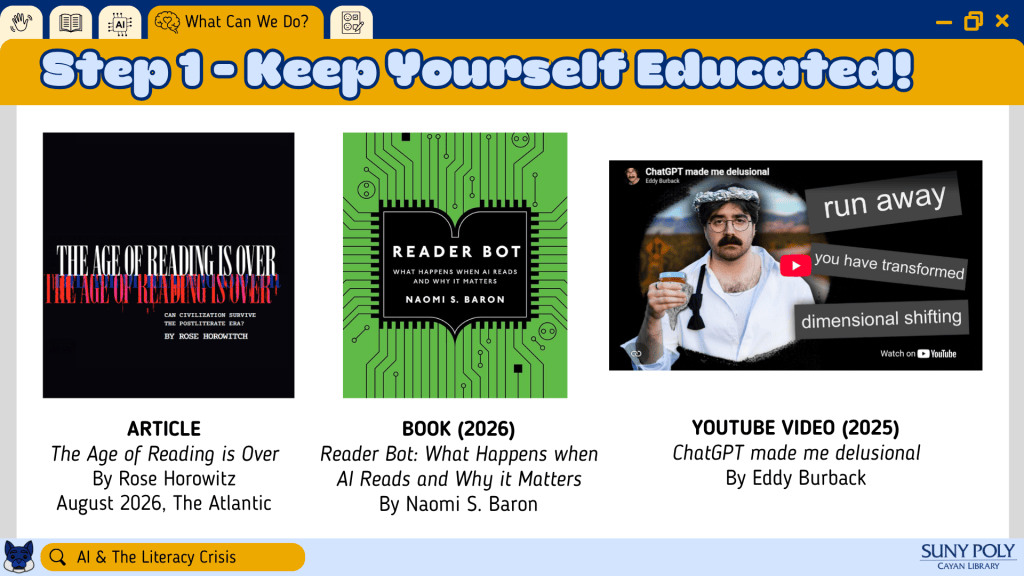
- Suggestion 1: The Age of Reading is Over [recently renamed to “The End of Reading is Here”]
- August 2026 Atlantic cover story/article written by Rose Horowitz
- Suggestion 2: Reader Bot: What Happens When AI Reads and Why It Matters
- January 2026 book written by Naomi S. Baron
- Suggestion 3: ChatGPT made me delusional
- October 2025 YouTube video by Eddy Burback
Step 2 – form your stance!
And your stance doesn’t always have to stay the same, it can fluctuate as you learn more about the technology! Me personally, I think it’s pretty clear I don’t want to touch generative AI with a 12 foot pole, but I always make sure to read up on a variety of stances to make sure I’m seeing things from both sides.
Step 3 – Educate those around you!
Share your knowledge! The main thing that I would say is important is to know your audience. For this presentation I think I was pretty clear on how I felt about the technology, but when I teach AI Literacy sessions to students on campus, I do keep that a little more on the down low to make sure they’re able to form their own opinions as they’re learning about a variety of aspects about the technology.
Usually in those sessions I give an overview of the types of AI, how they work, how AI impacts social media, mental health, higher education and the environment. Throughout the presentation I pause to give them time to reflect and share their thoughts on a worksheet I handout, then have small discussions between each topic so they can share their own opinions and learn how others see the topic!
The end?
Thank you so much for taking the time to read my post! If you have any suggestions, recommendations, or just want to share something related to this topic, please feel free to reach out to me via email. I’m always happy to chat and eager to learn more from others also looking into these topics.


Leave a comment